


Today, we are introducing the next must-have from our R2 system lineup: the Tuning Disc.
It’s a moment no starting electrophysiologist ever forgets: the plopping of action potentials when you listen to them on a speaker. The sounds that made generations of students decide to dedicate their professional lives to the hunt for brain cells.
With the advent of ultra dense, high channel count data, sonification has become less common. After all, who wants to pick and choose which of the 384 channels is the one to listen to? The era of listening to your data quietly ended when channel counts exploded. We think that’s a shame.
A tuning curve in 3D
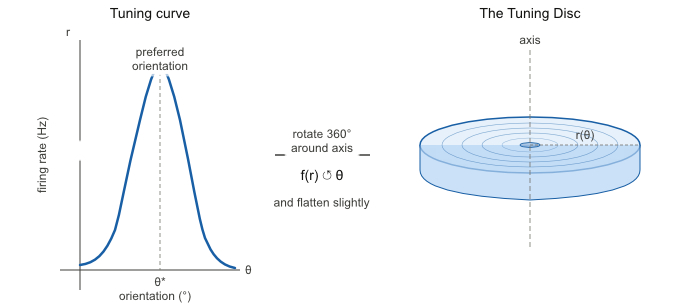
So we went back to the signal that started it all: a single neuron, a single orientation, and the curve that describes how it responds. The orientation tuning curve. A two-dimensional object: firing rate plotted against stimulus orientation, peaked at the cell’s preferred angle, falling away on either side. It lives in a plane. But if you rotate it 360° about its central axis, it becomes something else. It becomes a disc.
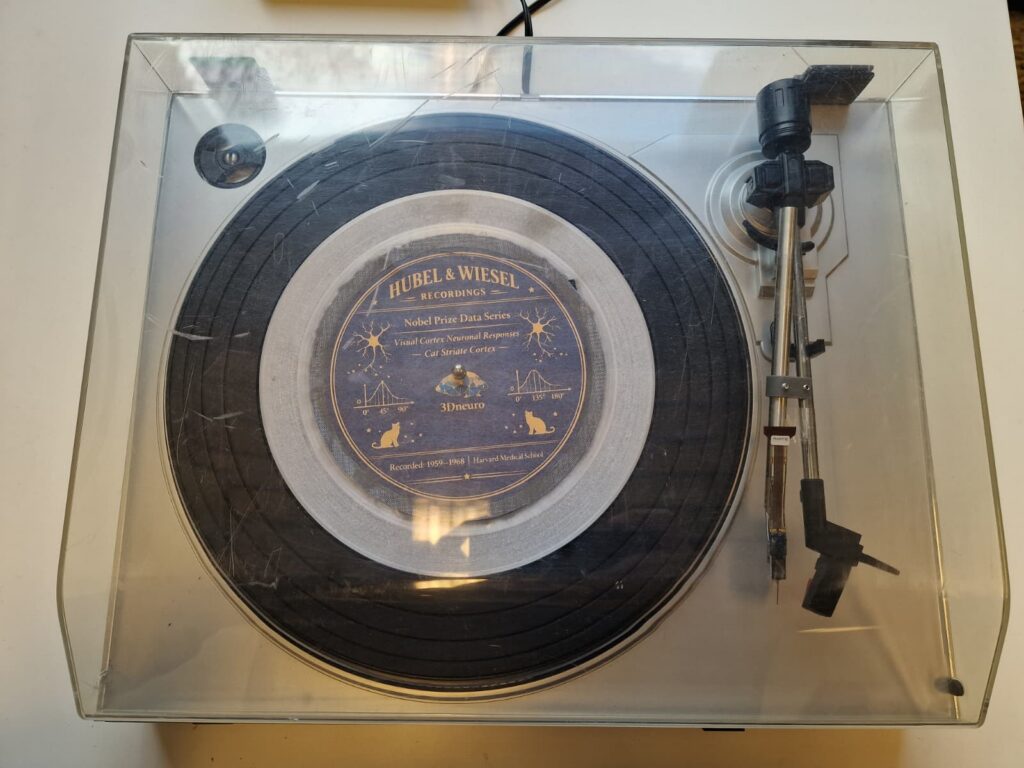
We made that disc. A 3D printed record, the ideal vehicle to immortalize the sounds of the first neurons you recorded.
Take the Spike Train
The grooves of the first Tuning Disc encode extracellular recording data from Hubel and Wiesel’s original experiments in cat primary visual cortex. Play it back at 33 rpm on a standard turntable, and listen to the spikes.
A sharper sound
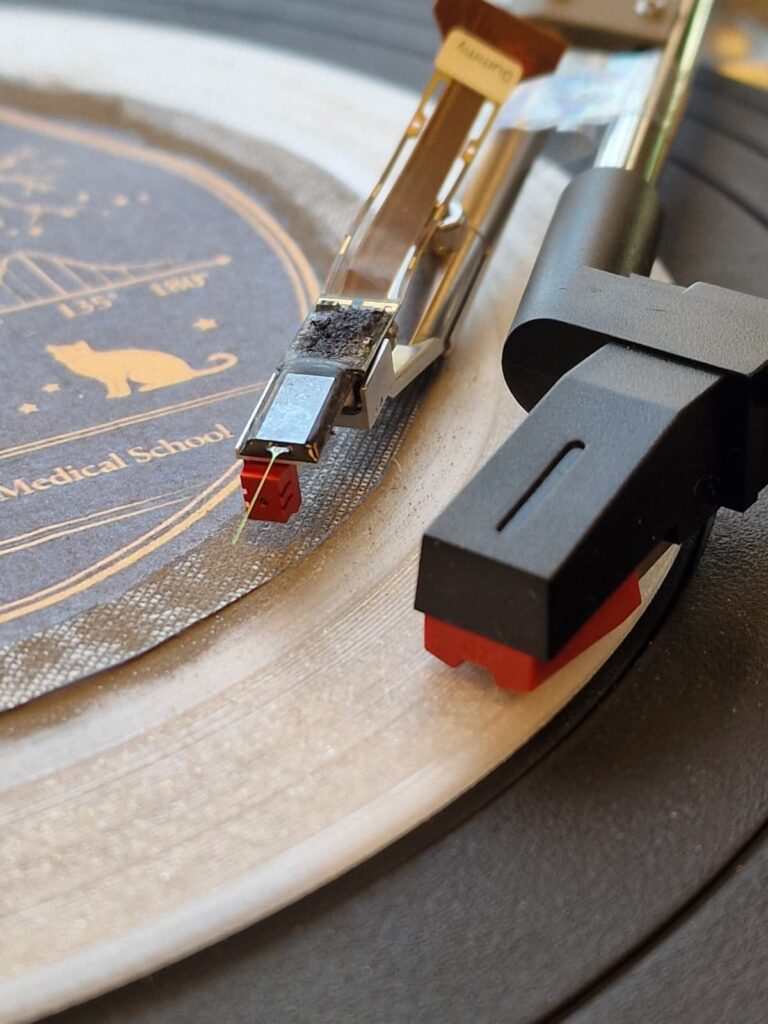
We love to combine form with function. This is why the Tuning Disc features a nanostructured abrasive surface that you can use to sharpen your Neuropixels probes ( https://github.com/cortex-lab/neuropixels/wiki/Sharpening ) while listening to the sonified spike trains. The Tuning Disc comes with a special adapter that allows you to connect your R2 System Stereotax Adapter to the tonearm of any standard record player. Lowering the needle onto the disc automatically aligns a Neuropixels probe in the adapter with the abrasive surface, starting the playback sharpens it. The duration of the track and width of the abrasive surface are optimized to balance sharpness of the probe and reliability of the process.
Putting the U in t-U-ning disc
The first edition of the Tuning Disc contains the seminal recordings of Hubel & Wiesel. For the true connoisseurs, we are preparing a version of the Tuning Disc with your data! Send us a spike train or LFP, and have it immortalized on your very own 3D printed record.